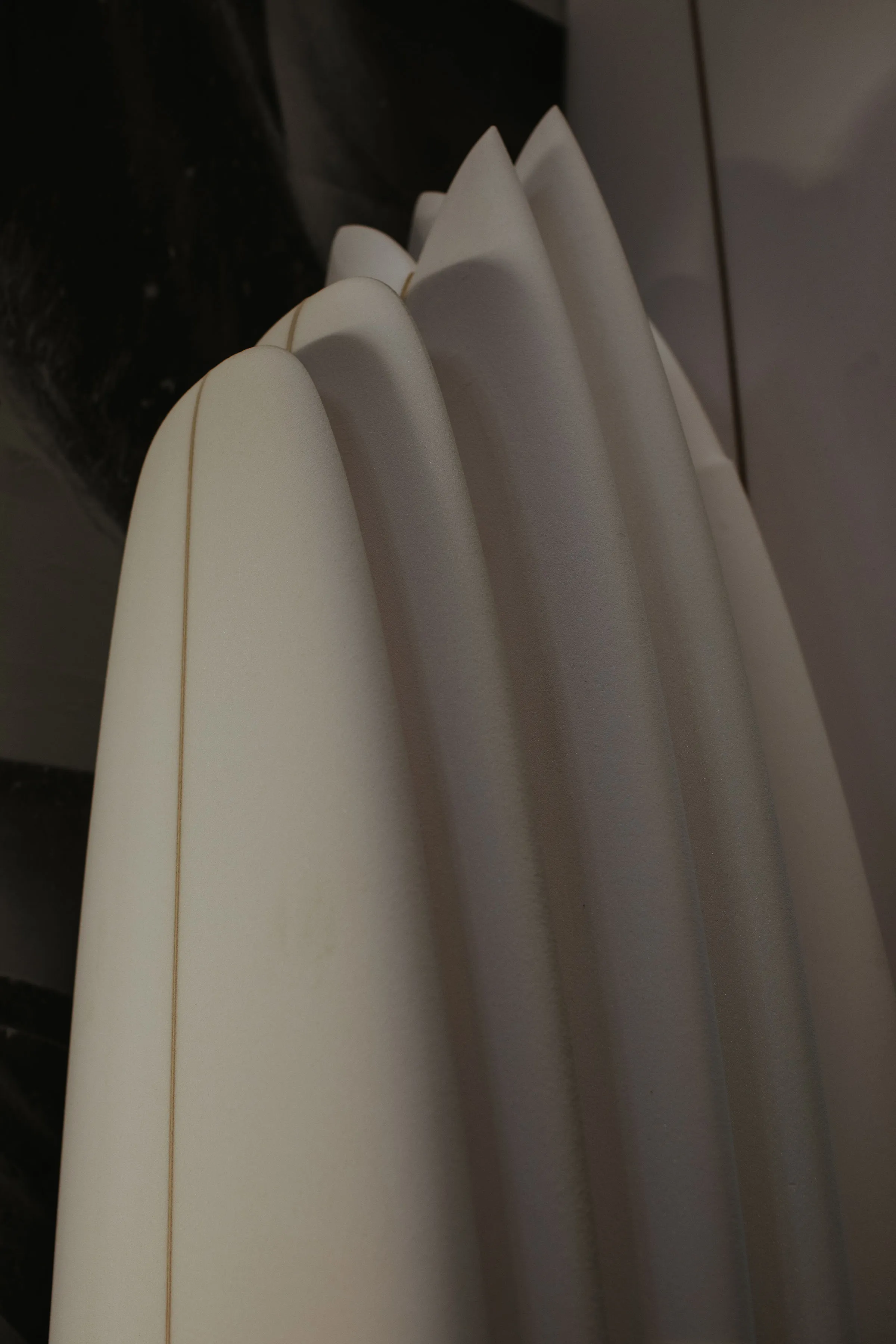
A board’s performance depends on a place you never see surfing: its bottom, the submerged face that manages water flow. For fifty years, a handful of shapers have run a fascinating investigation there.
The Bonzer system
Conceived by brothers Malcolm and Duncan Campbell in the early 1970s, the Bonzer pairs a centre fin with short, steeply raked side runners, coupled to a deep double concave that flares toward the tail. The result acts like a venturi: water is channelled under the board, drag drops, and speed projection out of a turn becomes fearsome. The Bonzer glides “on rails”.
Bottoms looking for something else
That quest continues with other shapers in the network:
- Neal Purchase Jr and his Duo models: two large parallel single fins near the rails, a hybrid between single-fin drive and twin-fin speed.
- Ellis Ericson and his Edge Boards: a longitudinal step creates two flow zones to reduce wetted surface at high speed.
- Joel Fitzgerald, a channel-bottom devotee, and Tyler Hatzikian, keeper of the classic Californian longboard with concave bottoms tuned for trim.
Reading a board from below
Understanding these designs means learning to read a board differently — not by its outline, but by how it organises water. The vocabulary (concave, vee, step, single-double) is detailed in our glossary, and is always chosen for a given programme and board family.
These legendary models are distributed and shaped in Europe within the UWL ecosystem — a way to make long-underground auteur research accessible.