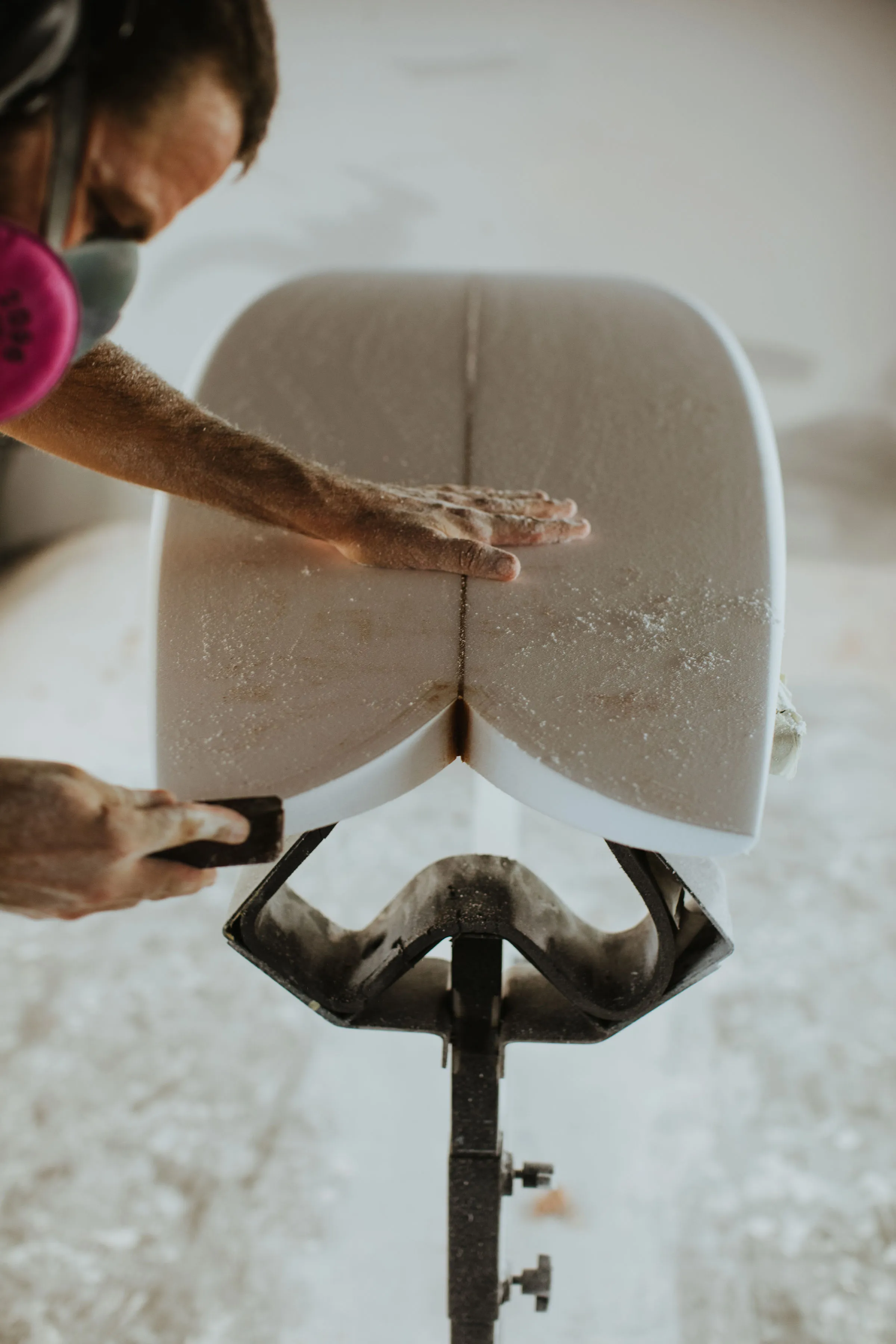
France’s alternative-surf revival owes a great deal to the early-2000s rediscovery of the fish twin fin: wide, thick, fast on the flat, with rare paddling comfort.
Addiction’s legacy
Between 2005 and 2008, hosting shaper Louis Robert under his Addiction label inside the UWL workshops helped popularise these retro shapes. Deep tinted resins, jeweller’s-grade pinstriping, precise bottom contours: the B-52 model remains an example of a board that’s fast in mushy waves while keeping a precise pivot. That’s the very definition of the modern fish.
The San Diego lineage
This culture feeds directly from the classic lines of San Diego, of which Larry Mabile and Jeff McCallum are keepers. Mabile excels at extremely fast traditional fishes; McCallum takes a more radical, sculptural approach — aggressive rails, asymmetric bottoms, high-end dark aesthetics.
These regular collaborations bring modern lamination techniques while preserving the purity of retro Californian lines. You’ll find these signatures among the shapers we keep alive in Europe.
Why it works
The twin fin frees the board: two fins, less drag, a “loose” glide that favours speed and fun over radical carving. In average, mushy waves — the daily reality for many surfers — it’s often the most fitting board. The trick is matching it to your programme and volume.
Built in Angoulins with the care of the UWL workshop, these boards blend local craft with the DNA of a school that shaped surfing worldwide.